UW 1020: POETRY & WRITING
THE ENEMY: THE VILLAINIZATION OF POVERTY
The Ghost
Do you not see him?
There, Beneath the façade of the People’s house;
a sheet drawn over his body,
preemptively announcing the arrival of Death.
Do you not hear the wheels of his chair grind
against the avenue where motorcades pass,
where sirens clear the road for Power,
but not for him?
You glance, or avoid completely
as if poverty were contagious,
as if white cloth could make him vanish.
What a ghost polite enough to cover his own face!
You fear the tent, the cough, the coin’s faint chime,
but not the marble lies etched in stone.
You fear the encampment as threat,
but not Him who scripts hunger as crime.
Call it order, call it peace,
while the avenue itself shakes
with the weight of what you refuse to carry?
But please, sip silence like soup,
spoon absence into your mouth,
mistake the hollow feeling in your stomach for
something holy,
something supreme.
And slowly, the sheet is lowering upon you, now.
The air will suffocate you long before
he disappears.
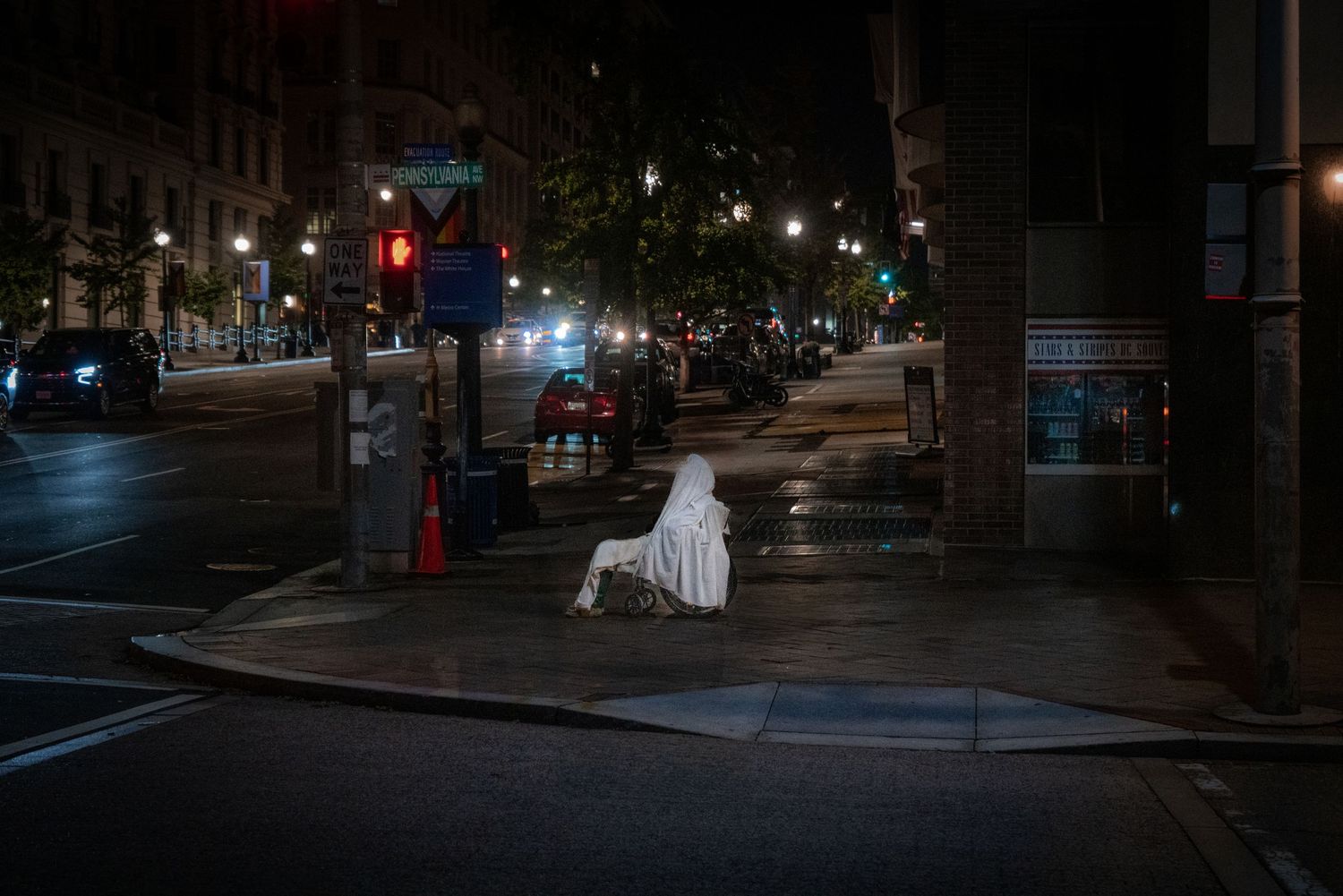
Late one evening, I was biking in D.C. and stopped at a crosswalk just across from Pennsylvania Avenue. There, just blocks away from the White House, I saw a man in a wheelchair under a white bedsheet. It startled me. The image felt symbolic of how poverty is treated in the city: people cover it, ignore it, act like it’s not there. The man looked like a body already written off. That moment became the central image for this poem and for the larger project. It was not just an illustration, but documentation. The poem frames poverty directly against the architecture of power and democracy, refusing the erasure that policies and statistics often produce.
At The Bottom
At the bottom of the escalator I saw her,
a strong, tired mother, her sari a blur.
At the bottom her toddler’s laugh filled the space,
a bit of sunlight leaking into the station’s bass.
At the bottom I saw people refuse her their eyes,
as if exile spread like a disease in disguise.
At the top of the escalator I saw another,
a boy turned away from his mother.
At the top the banana glowed yellow and bright,
its peel flashing gold in the harsh station light.
At the top I heard whining instead of a plea,
at the top I saw plenty that she may never see.
In the middle I stood, both witness and son,
in the middle I carried the two into one.
In the middle I thought of my mother in this land,
they once called her foreign, not quick to understand.
In the middle I wondered if love might endure,
if a look, or a glance, could begin to cure.
I wrote “At the Bottom” after seeing a mother and toddler at the Farragut West Metro station. Originally, I planned to write about statues in the Library of Congress. But on my way home, this scene changed my direction completely. The escalator split two worlds: below, a mother asking for help; above, another with abundance. Standing in between them, I felt the divide physically. The poem places me in the middle, both as a witness and as a son of an immigrant mother.